
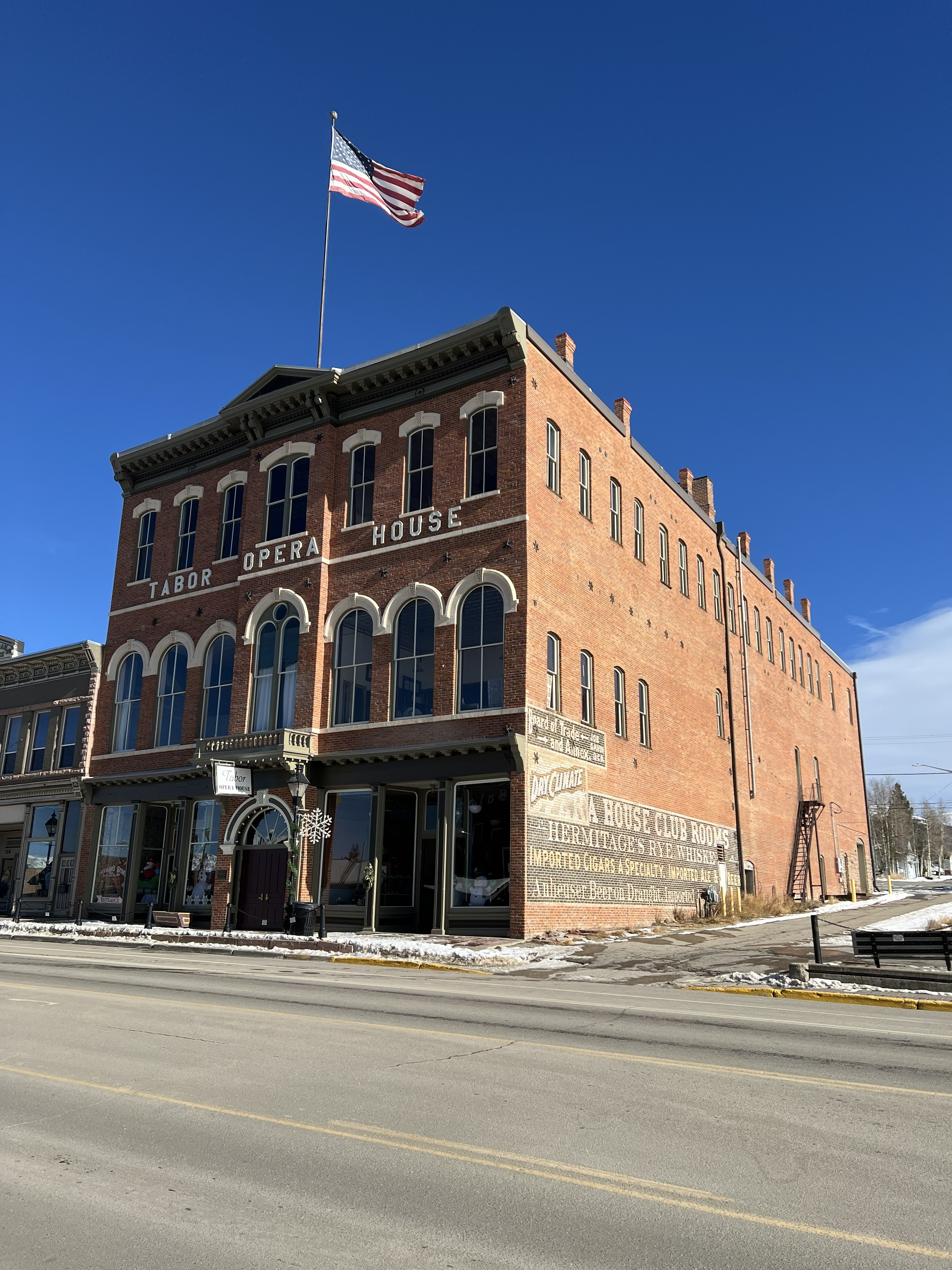
Tabor Opera House was built in 1879 by Horace A. W. Tabor in just 100 days and quickly became one of Leadville’s most important landmarks. Constructed at the height of the silver boom, the three-story stone, brick, and iron building brought art, culture, and architectural ambition to what was then one of the West’s roughest mining camps. Rising along Harrison Avenue at 10,152 feet above sea level, in the highest-elevation city in North America, the opera house stood as a bold statement that Leadville was more than a boomtown. Its original design included two retail stores on the first floor, an elegant theater on the second floor, and a third-floor connection to the neighboring Clarendon Hotel. The Tabor Opera House is also recognized as a National Treasure by the National Trust for Historic Preservation.
Tabor Opera House soon earned a reputation as the finest opera house west of the Mississippi. Over the years, notable figures including Oscar Wilde, John Philip Sousa, Buffalo Bill, and, according to local tradition, Harry Houdini, appeared on its stage, helping cement its place in Colorado’s cultural history. The building is also architecturally significant as one of Leadville’s earliest substantial downtown structures and as an exceptional surviving example of Victorian theater design in the American West. Its importance has only grown in recent years with the discovery of more than 250 hand-painted scenic compositions dating from 1879 to 1902, a collection now recognized as one of the finest surviving groups of historic stage scenery in North America.
The opera house’s history also reflects Leadville’s changing fortunes and the community’s long commitment to the building. After the 1893 silver crash, the property changed hands and briefly operated as the Weston Opera House. In 1901, the Leadville Elks acquired the building and carried out a major 1902 remodel that enlarged the stage and auditorium and created the larger stage and dressing rooms that survive today. That campaign was the building’s last major remodel, adding another important layer to the opera house’s architectural and cultural significance. Later, longtime owner Evelyn Furman played a major role in preserving the building’s legacy, and in late 2016 the City of Leadville purchased the opera house with grant funding, beginning its current era of public stewardship and rehabilitation.
The condition of Tabor Opera House has improved dramatically in recent years. Earlier preservation concerns centered on the building’s exterior envelope, where water infiltration and Leadville’s severe freeze-thaw cycles threatened the masonry and surrounding features. In response, the City of Leadville, Tabor Opera House Preservation Foundation, and community partners undertook a major exterior rehabilitation campaign over six construction seasons from 2020 through 2025. That work included masonry repair, restoration of windows and doors, preservation of historic ghost signs, and rehabilitation of the exterior balcony and cornice. With all four exterior walls now addressed, this highly visible campaign marks a major preservation success for one of Colorado’s most treasured historic theaters. The project has also been recognized with Colorado Preservation, Inc.’s 2022 Endangered Places Progress Award.
Today, the most urgent threat to Tabor Opera House is the roof. A recent assessment identified the roof as having exceeded its expected lifespan which is allowing water intrusion that threatens the underlying structure. The 2024 roof assessment identified severe deficiencies and recommended full replacement on an accelerated timeline, and subsequent city actions in 2024 and 2026 show that Leadville has continued pursuing grant funding and contractor selection for the roof replacement project. In Leadville’s high-altitude climate, where snow, wind, and repeated freeze-thaw cycles accelerate deterioration, the need for timely roof replacement is especially critical and the current goal is to have the roof project completed by 2027.
Tabor Opera House remains both an iconic historic landmark and an active cultural asset for Leadville. It is a contributing resource within the Leadville National Historic Landmark District, a source of community pride, and an irreplaceable link to Colorado’s theatrical, architectural, and mining history. Its exterior rehabilitation has significantly improved the building’s condition, but the site remains endangered until the roof is replaced. Protecting Tabor Opera House now means safeguarding not only its masonry and historic fabric, but also its rare scenic collection, its role as a community gathering place, and its long-term future as one of the West’s great surviving opera houses.