
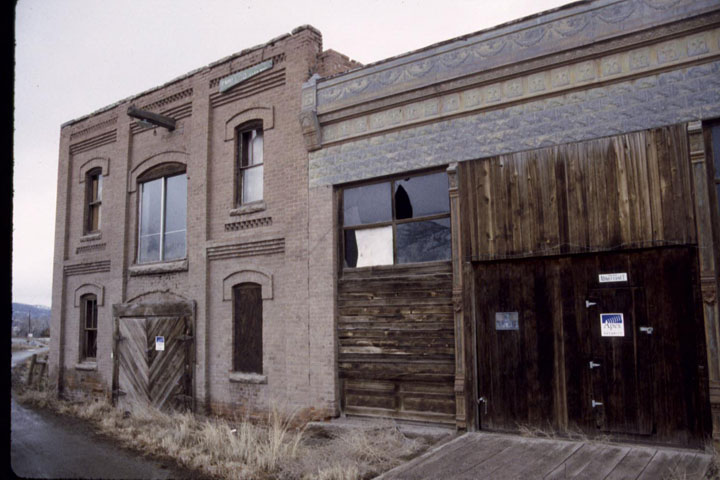
The Emma Store is one of the most important surviving historic commercial resources in the Roaring Fork Valley and a rare reminder of the once-thriving town of Emma. Located along Highway 82 between Basalt and Aspen, the brick store buildings stand as visible landmarks of a community that flourished first as a stagecoach stop and later as a station on the Denver and Rio Grande Railroad. Long before Basalt became the valley’s main mid-valley center, Emma was a local hub of commerce, transportation, and social life, and Emma Store was at the center of that activity.
The store buildings are closely associated with Charles H. Mather, an East Coast native who arrived in the Roaring Fork Valley in the late 1880s. After briefly trying ranching, Mather turned to merchandising and took over as Emma’s storekeeper and postmaster. He replaced the earlier log buildings at the junction of Emma Road and the railroad line with the substantial brick commercial buildings that still define the site today. By around 1898, the property included the side-by-side store and warehouse buildings, a small brick accessory building, and a Victorian brick residence now known as the Mather House. These improvements reflected Emma’s growing importance as a trade center serving area ranchers, farmers, and travelers.
Emma Store played a central role in the economic life of the surrounding valley. Historical accounts describe customers traveling long distances to buy goods there, and the business drew from a large agricultural territory. The store stood at a strategic location where the railroad, ranching economy, and valley road network came together. It was more than a place to buy supplies. The Emma Store was part of a broader townsite that included the schoolhouse, depot, post office, and nearby ranch buildings, making it a focal point for everyday life in Emma and the surrounding countryside.
The historic significance of the Emma Store is heightened by its rarity. The surviving brick store and warehouse are the only known Victorian-era commercial building examples remaining in Pitkin County. The west building is a two-story brick warehouse with an elegant brick façade, while the east building is a one-story store building with a framed storefront and decorative metal detailing. Together with the small accessory building, they preserve an unusually intact record of late nineteenth-century commercial architecture in the valley. Their visibility from the highway has made them one of the most recognizable historic sites in the Emma area, even for travelers who only catch a glimpse while passing by.
By the twentieth century, however, the Emma Store had entered a long period of decline. The mercantile business eventually closed, and although the buildings continued to host occasional dances, meetings, and community activity, commercial use faded. The decline of rail service and broader changes in the valley economy further reduced the importance of Emma as a town. By the mid-twentieth century, the store buildings were largely vacant, though they remained part of the working ranch landscape around them. What had once been a busy trade center became a quiet roadside landmark.
The greatest modern threat to the Emma Store came not from abandonment alone, but from the changing transportation corridor around it. Construction of the Highway 82 bypass in 1988 dramatically altered the setting of the townsite. While the new highway made the buildings far more visible, it also placed them in a harsh environment. Traffic vibration, snowplow impact, deicing chemicals, and difficult site access all accelerated deterioration. By the early 2000s, the buildings were in serious condition, and demolition became a real possibility. The Emma Store was listed on Colorado Preservation, Inc.’s Most Endangered Places list in 2000, bringing needed attention to the threat facing one of Pitkin County’s most important historic commercial resources.
A major turning point came in 2008, when Pitkin County Open Space and Trails purchased the 12.5-acre Emma Townsite parcel with funding assistance from the Town of Basalt. That acquisition made it possible to begin a multi-phase preservation effort focused on stabilizing the Emma Store and the associated accessory building. Immediate structural stabilization was completed in 2008 to prevent collapse. In 2010, a second phase of work repaired masonry, installed new roof structures, and stabilized the east and west store buildings. In 2012, additional work restored the accessory building. These projects were supported in part by State Historic Fund grants and returned the structures to stable, weatherproof shells. The buildings were also placed on the Pitkin County Historic Register, and preservation covenants now help guide future work.
The Emma Store is recognized as a Saved resource, but its long-term preservation story is still unfolding. While the exterior shells have been stabilized, the interiors remain unfinished and future adaptive reuse is still being planned. In 2021, Pitkin County completed a future use recommendation process for the the Emma Store buildings, emphasizing that any reuse should honor the site’s agricultural roots, respect the rural character of Emma, and provide a use that is accessible to the community. The planning process also recognized major constraints, including preservation standards, access limitations, and compatibility with the Emma Caucus vision for maintaining the area’s low-density agricultural and open space character.
Today, Emma Store stands as a rare and highly visible survivor of the Roaring Fork Valley’s early commercial history. Its significance lies not only in its architecture, but also in its role as the historic heart of Emma’s economic and social life. Preserving the Emma Store means protecting one of Pitkin County’s most important historic landmarks and ensuring that the story of this early valley crossroads remains visible long after the broader town around it has faded.