
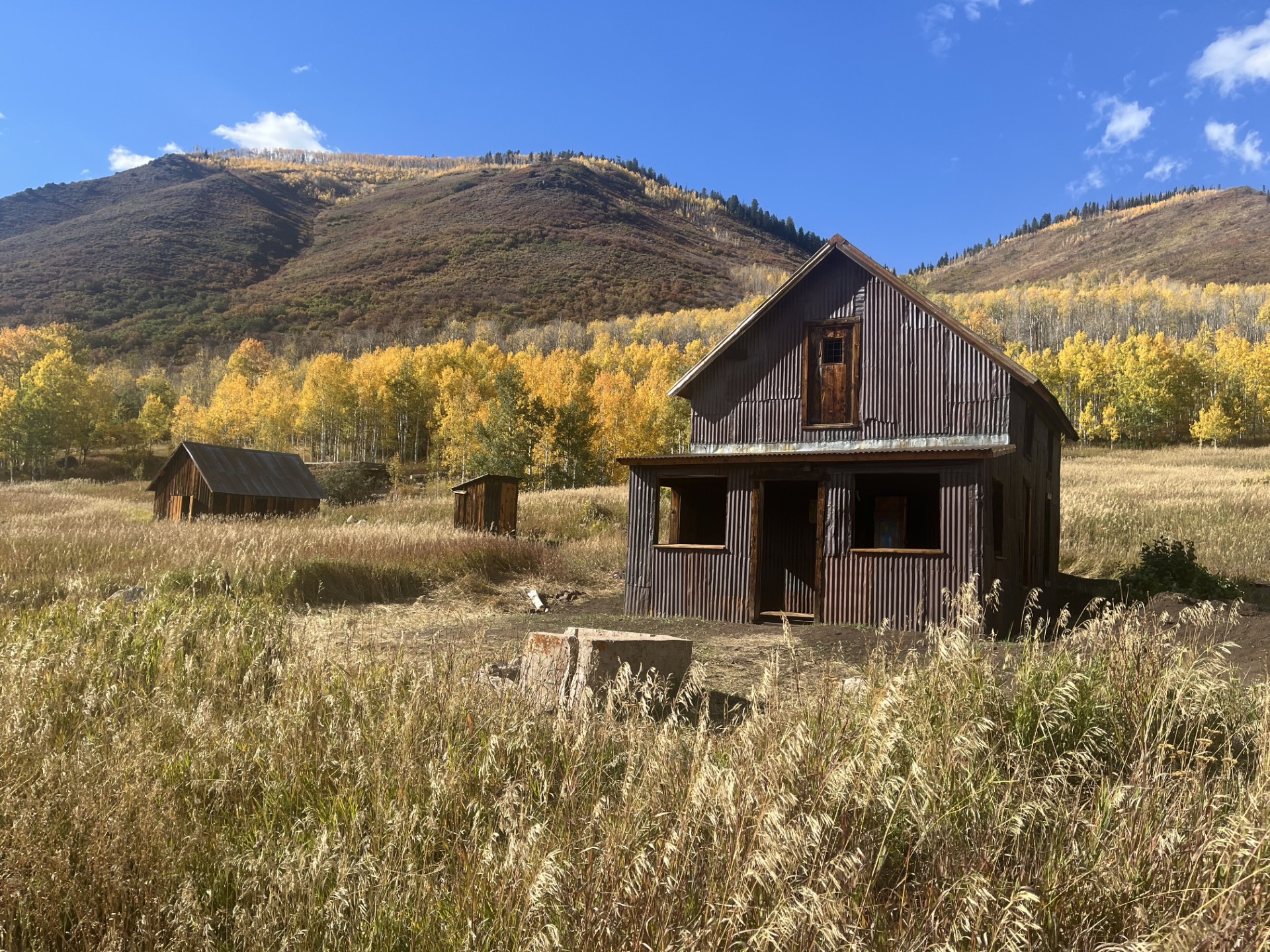
Koch Homestead is one of the most important surviving historic resource clusters in the Hunter Creek Valley near Aspen. Set within a beautiful high-country landscape now managed as part of the White River National Forest, the homestead reflects the earliest period of settlement and development in the Roaring Fork Valley. Established by William C. Koch beginning in 1883, with major ranch buildings largely completed by 1887, the site helped supply the growing mining community of Aspen with meat, produce, dairy products, hay, lumber, and other essential goods at a time when local survival depended on nearby sources of food and materials.
The significance of Koch Homestead extends beyond agriculture alone. The property is also tied to some of the very earliest non-mining activity in the valley and to the fragile first years of Aspen’s development. Historical accounts place some of the first prospectors who crossed over from Leadville in the winter of 1879–1880 in a cabin near the area that would later become the Koch ranch complex. As Aspen grew from a small camp into a booming mining town, the Hunter Creek Valley became a critical support landscape, and Koch Homestead emerged as one of its most important working properties.
William C. Koch was one of the valley’s early entrepreneurs who recognized that a mining camp also needed food, water, and infrastructure. In addition to ranching, Koch was involved in lumber operations and helped develop the productive agricultural landscape later known as the Adelaide Ranch. By the late 1880s, the homestead was an important local supplier, improving diets and daily life for miners and their families who otherwise depended on hunting or wagon shipments from outside the region. As one of the earliest farm and dairy operations in the Roaring Fork Valley, Koch Homestead represents a foundational chapter in Aspen’s settlement history.
The site is also closely associated with early water and power infrastructure. Just upstream from the main homestead is the Dam Keeper’s Cabin and the remains of the dam built in 1886 on Hunter Creek. That system provided Aspen with its first reliable source of fresh water and helped generate the hydropower that contemporary accounts celebrated as making Aspen the first town west of the Mississippi to use hydroelectric power for electricity. In that sense, Koch Homestead is not only an agricultural site, but also part of the broader story of how Aspen became a functioning modern community in the nineteenth century.
Today, Koch Homestead includes a cluster of historic buildings and related features that still convey this early history, even after decades of weathering and deterioration. The 60-acre site is owned by the U.S. Forest Service, located within the White River National Forest, and has been determined preliminarily eligible for listing on the National Register of Historic Places. Its surviving buildings stand as rare reminders of the valley’s agricultural, industrial, and settlement history, yet their importance has long been overlooked by many who pass through Hunter Creek without knowing the stories embedded in the landscape.
Preservation efforts in recent years have begun to change that. The Hunter Creek Historical Foundation, working in partnership with the White River National Forest and HistoriCorps, has successfully completed stabilization and preservation work on the Koch Homestead and additional outbuildings. Support for the effort includes major donations from the John W. Baird Access Fund of Trust for Public Land, Bruce Etkin Advised Fund at Aspen Community Foundation, Robert Glickman, and the Ronald D Austin Revocable Trust. With additional funding provided by local grants, foundations, and Community members, as well as support from Pitkin County, the Aspen Historical Society, Independence Pass Foundation, and Pitkin County Open Space and Trails. Recent work has included stabilization of the Shop building, while preservation efforts have continued on the Road House, the original Miner’s Cabin, and the Dam Keeper’s Cabin.
Today, Koch Homestead remains an active preservation effort and a powerful reminder of the entrepreneurial spirit that helped establish Aspen. Its buildings tell the story of a valley that once served as Aspen’s breadbasket, water source, and working landscape. Preserving Koch Homestead means protecting not just a group of old structures, but a rare and tangible link to the people, industries, and innovations that made permanent settlement in the Hunter Creek Valley and Aspen possible.